- Hydrogen Water Bottles
- Sizes & Comparisons
- Buying Guides
- Education & Care
- Hydrogen Water Bottles
- Sizes & Comparisons
- Buying Guides
- Education & Care
How to Test a Hydrogen Water Bottle at Home: Methods & Limitations
Leave a comment / Blog / By Zaryab / 3 Nov 2026

Quick Answer: How Do You Test a Hydrogen Water Bottle at Home?
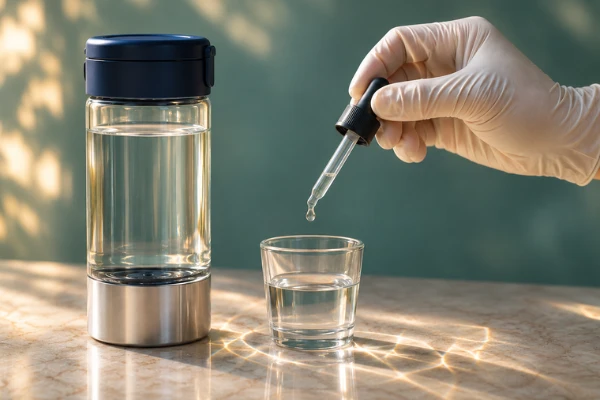
Use a hydrogen specific reagent kit or a genuine dissolved-H₂-selective meter, and follow its complete instructions. For reagent drops, measure the exact sample volume, test promptly after the bottle’s cycle, and use the kit’s endpoint and conversion factor to estimate concentration.
If your reading is lower than advertised, check the procedure and repeat under comparable conditions before judging the bottle. Bubbles, taste, ORP or a built in display alone cannot verify dissolved H₂ concentration. A home reading does not prove drinking water safety or health benefits.
Table of Contents
Your hydrogen bottle finishes its cycle, and the screen shows 3,000 PPB. One tutorial says to count blue drops; another recommends an ORP meter. If your test reads lower, is the test wrong, or is the bottle underperforming?
Start by understanding what your chosen method measures. A home test checks one sample under specific conditions. It does not establish the bottle’s output in every cycle or prove any health benefit.
Drawing on research and published guidance, this guide explains how to test hydrogen water at home, repeat the test fairly, and use a checklist to interpret your results.
Which Hydrogen Water Testing Method Should You Use?

Choosing a hydrogen water test can feel confusing when different tools promise similar answers. Start with what you want to check: a sample at home, repeated readings, or a disputed bottle claim. The table below shows what each method measures and where its limits matter.
| Method | Measures actual dissolved H₂? | Best use | Key limitation |
|---|---|---|---|
| Reagent drops specifically for hydrogen | Measures dissolved H₂? Yes, an estimate based on the kit | Best use Simple home checks | Key limitation Requires the specified sample volume, endpoint and drop factor. |
| H₂ selective sensor or meter | Measures dissolved H₂? Yes, if the sensor selectively measures H₂ | Best use Repeated instrument measurements | Key limitation Needs suitable calibration, detection range and sensor care. |
| ORP meter | Measures dissolved H₂? No, measures redox potential in mV | Best use Limited context about reducing or oxidizing conditions | Key limitation Cannot reliably convert mV into H₂ PPB or PPM. |
| pH, TDS, generic strips, bubbles or pressure | Measures dissolved H₂? No | Best use Checking other properties or observing operation | Key limitation Cannot quantify dissolved H₂. |
| Laboratory gas chromatography or suitable validated analysis | Measures dissolved H₂? Yes, with an appropriate method | Best use Investigating disputed performance claims | Key limitation Results depend on sampling, handling and test conditions. |
Cost and availability vary by kit, instrument and laboratory. This table does not imply a universal accuracy ranking.
How to Choose the Right Test for Your Needs
Check the Reagent Kit’s Instructions
For a simple home check, start with reagent drops specifically designed for dissolved hydrogen. Look for instructions that clearly state:
The exact water sample volume.
The colour change that marks the endpoint.
The hydrogen concentration represented by each drop.
A methylene blue/platinum reagent uses a specific chemical reaction to detect hydrogen. Ordinary blue dye, pH strips and generic water test chemicals cannot replace it. See the published research on this reagent method.
Ask About Laboratory Sampling Before Sending Water
For a disputed bottle claim, contact the laboratory first. Ask whether its method suits dissolved H₂ and how the sample must be collected, sealed and delivered. Check that the report identifies the bottle model and test conditions relevant to the claim.
What You Need Before Testing: Five “Test the Test” Checks

A low reading can leave you questioning your bottle. Checking your setup first helps you spot preparation mistakes before deciding what the result means.
Get Everything Ready
Before starting the cycle, set out your hydrogen kit, its specified graduated vessel, a compatible cup, timer, log and label required protective items. Keep the cup clean and dry if instructed.
Run These Five Checks
Correct Kit: Is this reagent specifically designed to test dissolved molecular hydrogen (H₂)?
Instructions: Do you know the required sample volume, colour endpoint, and conversion factor?
Reagent Condition: Is the reagent within its stated shelf life and stored according to the manufacturer’s directions?
Clean Equipment: Is your specified measuring vessel clean, ready, and suitable for the test?
Consistent Conditions: Can you repeat the same water source, fill volume, operating cycle, and sample timing?
If one of these checks fails, correct the setup before relying on a numerical result.
Record What You Did
Log model/version, date, water source, approximate temperature, charge and fill volume where relevant, cycle length/mode, sample volume, testing delay, reagent identity/expiry, endpoint drops, result and differences.
If your kit requires 6 mL, an unmeasured pour makes the reading “not comparable.” Measure correctly and rerun.
- Hydrogen test kit
- Measuring vessel
- Timer
- Test log
How to Test a Hydrogen Water Bottle with Reagent Drops

To test your hydrogen water bottle with reagent drops, follow one kit’s instructions from sample collection to the final reading. The steps below explain the workflow, but your kit determines the exact volume, mixing method and endpoint.
Follow One Complete Kit Procedure Step by Step
If you’re testing a new bottle for the first time, complete any initial setup or cleaning steps required by its manufacturer before generating your test sample. Don’t assume every bottle is ready for a meaningful comparison straight out of the box.
-
01 Read both sets of instructions
Check the bottle manual and kit directions for safe pressure release, sample volume, reagent handling, mixing and the colour endpoint.
-
02 Prepare before the cycle ends
Have your kit, timer and log ready. Use only water and a fill level permitted by the bottle manufacturer, then complete your selected cycle.
-
03 Collect a fresh sample promptly
Note the cycle-end time and measure the kit-specified volume, ideally directly into its vessel. Minimize splashing and intermediate containers, and record the delay. Dissolved hydrogen can escape during pouring, air exposure and measurement, changing the sampled concentration.
-
04 Add and mix as directed
Follow your kit’s dispensing and mixing instructions. Do not borrow stirring techniques, pauses or rapid-drop shortcuts from another kit’s tutorial.
-
05 Watch for the correct endpoint
With H₂Blue, early drops turn clear when sufficient hydrogen is present. Its instructions say to count the final drop that leaves the sample pale blue. Other kits may use different rules.
-
06 Record and clean up
Log the drop count, timing, sample conditions and estimated concentration using your kit’s conversion factor. Clean and store equipment as instructed.
Safety and Handling Notes
Reagents may stain or present chemical hazards. Follow the label and safety data sheet, wear required protection, and keep them away from children, pets and food. Never add reagent to your drinking bottle or drink the tested sample. Follow product label and local disposal requirements.
Never force open a pressurized bottle or bypass its pressure release procedure.
Why Protocols Cannot Be Mixed
Advice to minimize agitation during collection does not mean skipping required mixing. H₂Blue’s detailed guidance specifies gentle stirring, without shaking. Follow your kit’s complete procedure rather than combining instructions into a homemade method.
H₂Blue Colour Endpoint
Before endpoint
Blue turns clear
Early drops clear when sufficient H₂ is present, after mixing as instructed.
At endpoint
Stays pale blue
Count the final drop that leaves the sample pale blue, per H₂Blue instructions.
Educational illustration. Colours and timing are illustrative. Follow your kit’s instructions; other kits may differ.
How to Calculate PPB/PPM and Interpret the Drop Count

Once you have counted the drops, use your kit’s conversion factor to estimate concentration. That factor must match your reagent, sample volume and endpoint. The drop count alone does not tell you how much dissolved hydrogen is present.
Worked Example: H₂Blue’s 6 mL Procedure
Calculation demonstration only, not an actual bottle result.
H₂Blue’s published instructions include the final drop that leaves the sample pale blue:
23 drops × 0.1 mg/L per drop = 2.3 mg/L
In dilute water, this is approximately 2.3 mass based PPM, or 2,300 PPB. Before comparing that estimate with your bottle’s advertised figure, check whether the test conditions match.
Check Before Converting
On the same concentration basis, 1 PPM = 1,000 PPB. In dilute water, 1 mass based PPM is approximately 1 mg/L. See our PPB vs PPM guide for details.
If no conversion factor is provided, or you used the wrong sample volume, log the drops and deviation without assigning a concentration. Repeat correctly.
Zaryab’s Research Note
One detail I found particularly important when comparing published hydrogen-testing methods was that similar colour-change procedures do not always use the same sample volume or calculation.
For example, H₂Blue’s instructions specify a 6 mL sample with a particular drop-conversion factor, while a 2012 study by Seo and colleagues examined a different methylene-blue/platinum procedure using 20 mL samples.
That difference matters. Even if two methods appear similar, I wouldn’t apply one method’s drop factor to another without evidence that it is valid.
For someone testing a hydrogen water bottle at home, my recommendation is to follow the exact kit’s instructions, record the conditions, and treat the result as a sample estimate rather than proof of the bottle’s overall performance.
Drop Count Calculator
For H₂Blue’s published 6 mL procedure only.
Enter your drop count to begin.
Uses 0.1 mg/L per drop. Unit estimates assume dilute water. Calculation only; it does not verify your test or bottle. One drop remaining blue is inconclusive near the detection limit and does not confirm hydrogen is present.
Can You Use a Digital Meter or Test Without a Kit?

A digital display can make testing look simple, but first check what the device measures. Without a suitable test, you can check operation, not dissolved hydrogen concentration.
Digital Hydrogen Selective Meters
Look for a sensor specifically designed to measure molecular H₂. Check its measuring range, calibration standard, stabilization time, probe cleaning requirements, and handling and temperature instructions.
An ORP based “hydrogen meter” is not a direct concentration meter, even if its display shows PPB or PPM.
No Kit or Meter? Check Operation Only
Without testing equipment, you can check whether your bottle:
Turns on and completes its selected cycle.
Produces bubbles.
Makes pressure release sounds during normal operation.
These signs show aspects of operation, but they cannot confirm dissolved-H₂ concentration. Taste, smell, TDS, pH and generic strips cannot verify PPB or PPM either.
If verification matters, use a compatible hydrogen test kit or request the exact model’s published laboratory report. Avoid household-chemical mixtures, and never taste test reagents.
Can You Trust a Bottle’s Built In PPM Display?
Check the manufacturer’s explanation. Echo Water states that the Echo Flask estimates PPM from cycle time and expected performance, rather than measuring hydrogen with a built-in sensor. That example does not establish how every brand’s display works.
What Does Your Reading Tell You?
Your bottle produces bubbles and displays 3,000 PPB. Based on these signs alone, what can you conclude?
Why Is My Home Reading Lower Than the Bottle’s Claimed PPM?

Suppose your bottle advertises 3,000 PPB (3 PPM), but your home drops estimate 0.8 PPM. That gap can leave you wondering whether the test went wrong or the bottle is underperforming. Before deciding, check whether both figures involve the same model, comparable conditions and suitable measurement methods.
Troubleshoot the Test Before Judging the Bottle
Check the reagent. Confirm it measures hydrogen, is within its stated life and was stored correctly. Review the kit’s guidance on possible chemical interference.
Review the sample and method. Check vessel cleanliness, measured volume, mixing, endpoint and conversion factor. A factor intended for 6 mL cannot be applied to an incorrectly measured sample.
Check timing and handling. Record the delay after cycle completion. Collect promptly, minimize splashing and follow the kit’s mixing instructions.
Match bottle conditions. Compare the exact model/version, approved water, fill level, mode, cycle time and temperature. Check charge and maintenance only as the manual permits.
Repeat fairly. Test fresh samples from separate cycles under constant conditions. Establish a baseline before changing one suspected variable at a time.
Hydrogen Reading Helper
Reading lower than expected? Choose your method and concern for a practical troubleshooting plan.
Educational guidance, not a diagnosis, accuracy score or product certification. Follow your bottle and kit manuals. A concentration reading does not establish water safety or health benefits. No entries are saved or sent by this tool.
What If It Remains Low?
Keep dated logs and contact the brand with your model, advertised claim, cycle/mode, water, kit and readings. Request a model specific dissolved H₂ report showing relevant conditions, and check warranty evidence requirements.
Consistently low readings justify investigation, but do not automatically prove the bottle is fake.
How to Record and Interpret Repeat Tests

Keep each reading alongside its test conditions so you can compare runs without relying on memory. Use the log below, or record the same details on paper.
Your Three-Run Test Log
Use a fresh sample from a separate cycle for each run. Keep conditions consistent. Prompts below are examples, not measured results.
Only enter a concentration if your kit supplies the correct conversion factor and you followed its complete procedure. Include PPB, PPM or mg/L. Otherwise, enter “Not comparable” and explain why in Notes.
Entries are not saved automatically. Download your log before leaving.
Compare Results Without Assuming a Fault
For a hypothetical kit specifying 6 mL and 100 PPB per endpoint drop:
Trial 1: 18 drops = 1,800 PPB (1.8 PPM).
Trial 2: 21 drops = 2,100 PPB (2.1 PPM).
These are fictional calculations, not measured results or an established tolerance. Keep both entries. Review sampling delays, endpoint interpretation and other recorded differences before drawing conclusions. The gap alone does not establish a defect or an accuracy percentage.
What Your Results May Mean
Blue persists on the first drop: H₂ may be below the kit’s detection range; this does not prove zero hydrogen.
Readings vary: Examine your setup and handling.
Bubbles appear but readings are low: Visible gas does not quantify dissolved H₂.
ORP is negative: It cannot provide a numerical PPB reading.
Ask: “What did this fresh sample estimate under these recorded conditions?” One result does not guarantee every bottle or cycle performs alike.
What Home Testing Cannot Prove

A home reading estimates one sample under recorded conditions. It cannot certify every cycle, production batch or long term reliability, or settle comparisons with laboratory results obtained under different conditions.
Safety and Health Need Separate Evidence
Measuring H₂ does not test for chlorine, ozone, heavy metals, microbes or other contaminants; drinking water safety requires appropriate separate tests.
A concentration reading also establishes neither a health benefit nor an effective dose; see our Hydrogen Water Benefits article.
When Laboratory Analysis Helps
For disputes or controlled independent verification, consider gas chromatography or a validated H₂ selective method. Our Lab Reports guide explains how to check the model, sample conditions and method.
The 2012 Seo et al. study compared a particular 20 mL methylene blue/platinum procedure with electrochemical analysis, discussing hydrogen loss and dissolved-oxygen effects under its conditions. It does not validate every home kit.
Frequently Asked Questions
Can I test my hydrogen water bottle without a kit?
You can check whether it runs, but bubbles, taste or a display alone cannot give a dependable numeric H₂ reading. Use a suitable kit, selective meter or relevant laboratory evidence.
Can I use any blue test drops?
No. Reagent chemistry, sample volume, endpoint and conversion rules vary. Use drops designed for hydrogen. If no conversion factor is provided, record your observations without assigning a PPB or PPM concentration.
Can an ORP meter show hydrogen concentration in PPB?
No reliable conversion turns ORP into hydrogen PPB or PPM. ORP measures redox potential in millivolts; a genuine H₂-selective sensor uses a different measurement principle.
Why do repeat tests show different numbers?
Sampling delays, volume, water conditions, reagent handling and endpoint interpretation can change results. Compare fresh samples from separate cycles using matched conditions, and note any differences in your log.
Does one low result mean my bottle is faulty or fake?
Not by itself. Check the procedure, repeat the test and compare the advertised conditions. If readings remain low, contact the brand with your records and request supporting documentation.
Why are there bubbles if my hydrogen test reads low?
Visible gas does not quantify dissolved H₂. Review sampling time, handling and kit instructions before treating bubbles as evidence that the measured concentration should be higher.
Does a high result prove the water is safe or healthy?
No. Hydrogen concentration does not test contaminants or establish health benefits. Drinking-water safety needs appropriate separate tests, while health claims require relevant clinical evidence.
Final Thoughts
If your home reading differs from the bottle’s claim, check your testing process first. Use an H₂ specific tool, prepare before the cycle ends, and follow one complete procedure. Collect the sample promptly and record its conditions.
Repeat under comparable conditions before deciding what a low reading means. If the difference remains unexplained, contact the manufacturer with your records. For a dispute or stronger performance verification, seek suitable laboratory evidence.
About the Author
Hi, I'm Zaryab, and I help manage Water Bottle Experts. I contribute to research and practical buying guides by examining manufacturer documentation, technical information, and product-owner experiences. For hydrogen water topics, I focus on explaining measurement methods, identifying the limitations behind advertised figures, and helping readers distinguish useful evidence from claims that still need verification.
About This Article
This guide was researched and written by Zaryab, a contributor and co-manager at Water Bottle Experts.
It explains home hydrogen-testing methods using published manufacturer instructions, scientific research on hydrogen measurement, and practical guidance on sample handling, repeatability, and result interpretation.
The calculations and test scenarios are educational examples, not measurements performed on a hydrogen water bottle for this article. No original laboratory testing or independent verification of manufacturer performance claims was conducted.
The goal is to help readers understand what a home test can reveal, recognize potential sources of measurement error, and make informed decisions when results differ from advertised claims.