- Hydrogen Water Bottles
- Sizes & Comparisons
- Buying Guides
- Education & Care
- Hydrogen Water Bottles
- Sizes & Comparisons
- Buying Guides
- Education & Care
Hydrogen Water Bottles: The Verification-First Guide to Buying With Confidence
Leave a comment / Blog / By Zaryab / 27 Nov 2026

Quick Answer: What Should You Check Before Buying a Hydrogen Water Bottle?
Start with a third-party lab report for the exact bottle model. Look for the measured dissolved hydrogen level, the amount of water tested, and when the sample was taken. A reading taken right after the cycle can be higher than what’s left by the time you drink.
Then confirm that the bottle uses an SPE/PEM membrane and that the seller names the electrode materials. When comparing bottles, put the readings in the same unit. 1,600 ppb equals 1.6 ppm.
Table of Contents
You can’t see, taste, or smell dissolved hydrogen in water. So when two hydrogen water bottles look similar and one claims 5,000 ppb, what makes that higher number worth paying for?
As someone who regularly goes to the gym, I know that details like capacity, leak resistance, portability, and ease of cleaning matter in everyday use. But performance claims deserve just as much attention.
Imagine paying for a bottle advertised at 5,000 ppb, only to find an independent lab measures less than 1,600 ppb under the same conditions. That’s less than a third of the promised concentration, and you wouldn’t notice the difference by taste.
This guide explains how to verify hydrogen water bottle claims, compare ppm and ppb, assess key features, and use lab reports and a practical checklist to make a more informed buying decision.
Key Takeaways
- Verify the PPB claim. Ask for a third-party lab report for the exact bottle model. Check the water volume, cycle length, and when the sample was taken.
- Know the numbers. 1 ppm equals 1,000 ppb. At room temperature and normal pressure, water in contact with pure hydrogen holds about 1,600 ppb at equilibrium. Higher readings need documented test conditions.
- Check the hardware. Look for an SPE/PEM system with platinum-coated electrodes.
- Consider how much you drink. Your dose depends on the volume you finish and how much hydrogen is still dissolved when you drink it.
Hydrogen Water Bottle Claim Checker
Answer five questions about a bottle on your shortlist to see what to verify before buying.
Your result is based on the listing and report details you select.
What Is Hydrogen Water? What the Research Says

Hydrogen water is ordinary drinking water with extra molecular hydrogen gas (H₂) dissolved in it. The water itself is still H₂O. When a bottle advertises a hydrogen concentration in parts per billion (ppb), that figure refers to the amount of dissolved H₂ in the water.
Is Hydrogen Water the Same as Alkaline Water?
Alkaline water gets its name from its higher pH. Hydrogen water gets its name from the gas dissolved in it. Water can be both alkaline and hydrogen rich, but each property needs its own measurement. If a seller shows you a pH reading, ask for the dissolved hydrogen result to verify the PPB claim.
What Do Human Studies Say About Hydrogen Water?
A small pilot study in soccer players reported less muscle fatigue during a short exercise test. A separate four week trial in healthy adults found changes in some inflammation related markers. If you’re hoping to recover faster between workouts, the research is still too limited to tell you whether drinking hydrogen water will make a noticeable difference.
A 2024 systematic review of six studies involving 76 participants found a small improvement in antioxidant capacity but no significant reduction in exercise induced oxidative stress markers. However, the published scientific review included hydrogen rich water, hydrogen baths, and hydrogen inhalation, making it difficult to determine the specific benefits of drinking hydrogen water. Larger and more rigorous studies are needed to confirm these findings.
If you’re comparing bottles, start with what you can verify before you buy. Ask for a third party lab report that shows how much dissolved hydrogen the exact model delivers.
Hydrogen Water Publications by Year
PubMed-indexed publications · 2016–2025- 20167
- 20179
- 201815
- 201915
- 202014
- 202117
- 202221
- 202310
- 202415
- 202515
Many human studies are still small. A 2024 review of molecular hydrogen and exercise-related oxidative stress included just 76 participants across six studies. Read the review.
Annual counts reflect records returned by a PubMed search for “hydrogen water.” View the published counts.
What PPB and PPM Mean on a Hydrogen Water Bottle

One bottle advertises 1,500 ppb. Another lists 1.5 ppm. They’re claiming the same concentration. Before you pay more for either bottle, check how much water it used to reach that figure and when the reading was taken.
How to Compare Bottles That Use Different Units
1 ppm equals 1,000 ppb. Divide the ppb figure by 1,000 to compare it with a ppm figure measured on the same basis. In dilute drinking water at room temperature, 1 ppm by mass is about 1 mg/L of dissolved hydrogen.
If a seller lists one figure on the box and another in the lab report, our PPB to PPM conversion guide walks through how to put both numbers in the same unit before comparing them.
| Claimed PPB | Equivalent PPM | Approx. mg/L | What It Means |
|---|---|---|---|
| 500 | 0.5 | 0.5 | About one-third of the benchmark |
| 1,000 | 1.0 | 1.0 | A little over half the benchmark |
| 1,600 | 1.6 | 1.6 | Close to the saturation benchmark |
| 2,000 | 2.0 | 2.0 | About 25% above the benchmark |
| 3,000 | 3.0 | 3.0 | Nearly twice the benchmark |
| 5,000 | 5.0 | 5.0 | More than three times the benchmark |
Benchmark · About 1.6 mg/L at 25°C with pure hydrogen at normal atmospheric pressure. Figures are unit conversions of example claims. The mg/L values are approximate for dilute water.
Can a Hydrogen Water Bottle Really Exceed 1.6 ppm?
Yes. At 25°C (77°F), water in contact with pure hydrogen gas at normal atmospheric pressure holds about 1.6 mg/L at equilibrium. Higher pressure lets more hydrogen dissolve. Once you open a pressurized bottle, the water can briefly hold more hydrogen than it can sustain under the new conditions. That’s called supersaturation. The concentration can then fall as hydrogen escapes into the air.
When a listing says “up to 5,000 ppb,” look at how the number was obtained. Was it the highest reading from one run or the average across several runs? If you usually sip over a few minutes, a reading taken after the cap has been off for that long tells you more about what you’ll drink than a reading taken as soon as the cycle ends.
Why Hydrogen Concentration and Water Volume Both Matter
250 mL at 2.0 mg/L contains 0.5 mg of dissolved hydrogen. If you finish 500 mL at 1.6 mg/L, you get 0.8 mg. The second serving gives you more hydrogen even though its concentration is lower. To estimate the amount you drink, multiply the concentration in mg/L by the volume you finish in litres.
Before you buy, ask two questions about the number on the box. “At what fill volume?” and “How long after opening was it measured?” Those details are what let you compare one claim with another.
How SPE/PEM Technology Works in a Hydrogen Water Bottle

When a hydrogen water bottle lists SPE/PEM, it’s describing how the bottle separates the gases it produces. SPE stands for solid polymer electrolyte, and PEM stands for proton exchange membrane. The membrane is a thin layer that lets hydrogen ions pass through while keeping the two sides of the electrolysis cell separate.
Why the Membrane Matters
Electrolysis produces hydrogen and oxygen. In a basic single chamber bottle, both gases can bubble through the drinking water. A membrane equipped bottle can direct hydrogen into the water and vent oxygen separately. Our comparison of standard and SPE/PEM electrolysis shows how the two designs handle those gases.
If you’re comparing two SPE/PEM bottles, check the measured dissolved hydrogen for each model. The membrane tells you how the bottle handles the gases. The lab result tells you how much hydrogen ends up in the water.
What to Look For in the Electrodes
Check the manual or spec sheet for the electrode material and any coating. Platinum is commonly used on the side that produces hydrogen, while iridium-based materials are often used on the oxygen side. These materials are chosen to withstand the conditions inside the cell, though even coated components can wear over time.
If the listing only says “electrolysis” or “ionizer,” ask the seller two questions. Does this exact model use an SPE/PEM membrane? What are the electrodes made of or coated with? If the seller can’t show you those details in writing, treat both features as unverified when deciding whether the bottle is worth the price.
Inside an SPE/PEM Hydrogen Water Bottle
Anode
Water enters ↓Oxygen and hydrogen ions form.
Oxygen vents ↑PEM
H+ →Hydrogen ions cross to the cathode.
Cathode
H2 forms ↓Some hydrogen gas dissolves in the drinking water.
The Verification Gap: Why Hydrogen Water Bottle Claims Differ From Results

The number on the box might be an estimate based on the selected cycle or the highest reading taken right after it ended. If you’re paying extra for higher PPB, ask what the brand actually measured. The figure that matters to you is how much hydrogen is still dissolved when you drink the water.
What Changes the PPB Reading?
Hydrogen can escape quickly once you open the bottle, especially if you pour the water into a glass and leave it sitting. A poor seal can also let gas escape while the bottle is closed. So a reading taken ten minutes after a cycle means more when you know how the water was stored and when the cap came off.
The starting concentration can vary too. Water temperature affects how much hydrogen can dissolve, and mineral content can affect how some generators perform. Check the fill volume and cycle length before comparing results. A brand might quote a reading from its longest cycle, while you plan to use the quick setting with a full bottle.
If your bottle’s screen shows a PPB figure, check whether the model measures dissolved hydrogen or estimates it from the cycle. That distinction is one reason the PPB on a bottle’s display can differ from a lab reading.
3,000 PPB on the Box, Under 1,000 PPB in the Glass
Hypothetical example. A bottle advertises 3,000 ppb. Ten minutes after the cycle ends, a calibrated meter designed to measure dissolved hydrogen reads under 1,000 ppb in a glass. That’s less than a third of the advertised concentration at the time of sampling.
Did the bottle start below 3,000 ppb, or did hydrogen escape after opening? You’d need an end of cycle reading and a ten minute reading using the same water, fill volume, and cycle setting. Recording when the cap came off and when the water was poured helps you tell the difference.
What Should a Lab Report Show?
An in-house test tells you what the manufacturer recorded under its own conditions. A third party report gives you an outside measurement to compare with the claim. Look for the exact bottle model, the method used to measure dissolved hydrogen, and the sampling time. A result taken immediately after the cycle is most useful if that’s also when you drink it.
Claim vs. Reality Worksheet
How to Verify a Hydrogen Water Bottle Before You Buy

If a seller charges more for a higher PPB rating, ask for the full lab report. It should show what the exact bottle delivered, how the lab measured it, and when it took the sample. Those details matter if the brand tested its longest cycle but you plan to use the quick setting every morning.
Step 1. Check the Third-Party Lab Report
Start with the lab name, report number, test date, and exact bottle model. Then look for the dissolved hydrogen test method, the result and its units, the fill volume, the cycle setting, and the time between generation and sampling. In our walkthrough of the published Echo Go lab report, you can see how those fields help you judge what a result actually supports.
A cropped screenshot can hide the setup behind the headline number. Ask for the complete report and, if you’re unsure it’s genuine, contact the lab through its own website with the report number. If the report cites accreditation, check that it covers the method used. Even a genuine report can be quoted selectively. Look for the individual readings or an average so you can see whether the listing highlights a single peak.
Step 2. Know What Home Testing Can Tell You
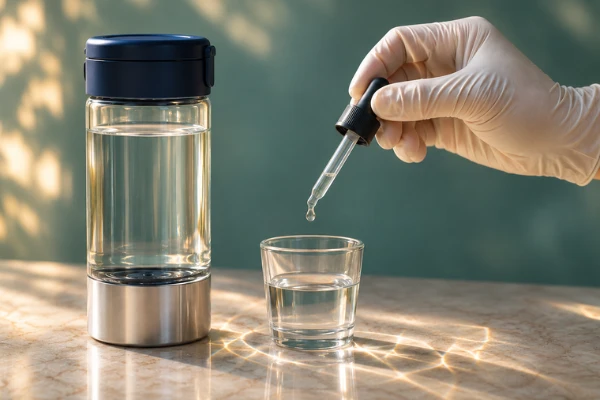
Home testing is useful once you have the bottle. You can compare a fresh sample with one that’s been sitting for ten minutes, for example. A calibrated meter with a hydrogen-specific sensor can measure dissolved H₂. Reagent drops give you a rough estimate, and the sample size and final color change both matter. Our reagent-drop testing walkthrough shows how to count the drops and interpret the result.
Hydrogen Water Testing Methods Compared
| Method | What It Measures | Reliability for H₂ | Cost (USD) | Best Use |
|---|---|---|---|---|
| Gas chromatography | Hydrogen extracted from a water sample | Lab-grade with documented sampling and calibration | Lab quote | Verifying an advertised concentration |
| Hydrogen-specific meter | Dissolved H₂ using a dedicated sensor | Good within the meter’s calibrated range | Varies by model | Repeat readings under the same conditions |
| Methylene blue drops | Estimated dissolved H₂ from a color change | Approximate. Sample size and technique matter. | About $30–$40 | Low-cost home screening |
| ORP meter | Redox potential in millivolts | Unsuitable for measuring dissolved H₂ concentration | Varies by model | Checking redox potential |
| Visible bubbles | Gas forming or leaving the water | No concentration reading | Free | Checking whether the bottle produces bubbles |
Buying tip. Ask for a third-party report for the exact model before paying extra for a higher PPB claim. Reagent prices reflect listings reviewed in November 2026.
Hydrogen Water Bottle Buying Checklist: 7 Things to Check Before You Buy

If a higher PPB rating is the reason a bottle costs more, ask for the lab report before you pay the difference. Once you’ve checked the output claim, compare the things you’ll deal with every day, from how often the bottle needs charging to whether it leaks in your bag.
- Confirm the membrane and electrode material. Check the manual or spec sheet for an SPE/PEM membrane and named electrode materials or coatings. If the listing only says “advanced electrolysis,” ask for the specifications for that exact model.
- Compare hydrogen claims in the same unit. Divide ppb by 1,000 to get ppm on the same measurement basis. A claim of 1,500 ppb equals 1.5 ppm.
- Get the full third party lab report. Check the model, measurement method, fill volume, cycle setting, and time between generation and sampling. If the seller promotes a peak reading, see whether the report also gives individual readings or an average.
- Check the cap, seal, and build. Look for a replaceable gasket and check whether spare seals are available. If you’ll carry the bottle in a bag, look for recurring reports of leaks around the cap or base.
- Compare cycles per charge on the setting you’ll use. If the seller quotes a cycle count for the quick setting, ask how many runs you’ll get on the longer cycle. That’s the number that matters if you plan to use it daily.
- Read what the warranty covers. Check whether the battery, charging port, cap, and seals are included. Some parts may have shorter coverage than the bottle itself.
- Find out if you can return it after trying it. Check the return window, whether you can return a bottle after running a cycle, and who pays for return shipping.
Once you’ve narrowed it down to a few models, think about where you’ll use the bottle and how often you’ll refill it. Our guide to choosing a hydrogen water bottle covers the trade offs between capacity, portability, and upkeep.
How Much Should You Pay for a Hydrogen Water Bottle?
Prices below are shopping benchmarks based on U.S. listings reviewed in November 2026. Features overlap across tiers. One $99 model listed SPE/PEM and platinum coated electrodes, while another bottle with a $299.99 list price appeared at $239.99 on sale. Compare the actual selling price and the features you’ll use.
Hydrogen Water Bottle Price Tiers
| Price Tier | Price (USD) | What You May See | What to Check |
|---|---|---|---|
| Entry | $50–$89 | Discounted portable models. | Ask for the electrode specs and full lab report if either is missing. |
| Mid-range | $90–$149 | SPE/PEM, named electrode coatings, or multiple cycles on some models. | Check which cycle and fill volume produced the advertised reading. |
| Premium | $150–$249 | Higher advertised output on some models, plus features like quick cycles or USB-C charging. | Compare how much hydrogen is in a full serving when you’d normally drink it. |
| Flagship | $250+ | High advertised concentrations, with examples around $279–$300 at list price. | Look for repeat readings and check whether you’ll use the extra features. |
Price basis. These tiers are based on U.S. listings reviewed in November 2026. Features overlap, and sale prices can move a bottle into a lower tier.
Is a Dissolved Hydrogen Meter Worth Buying?
If you want to check output regularly, look for a calibrated meter with a hydrogen specific sensor. Check how it’s calibrated, what range it measures, and how small a change the display can show. For an occasional check, reagent drops cost less and give you a rough estimate.
Pay extra for features you’ll use and performance the seller can document.
7 Checks Before You Buy a Hydrogen Water Bottle
Tick each item as you compare bottles.
Frequently Asked Questions
What is the difference between PPB and PPM?
They are two ways of expressing the same thing: concentration. One part per million (ppm) equals 1,000
parts per billion (ppb). So 1.6 ppm is the same as 1,600 ppb. Brands often use ppb because the larger number looks
more impressive, but the concentration is identical once you convert.
Is a higher PPB number always better?
Not necessarily. Dissolved hydrogen saturates at roughly 1.6 ppm (1,600 ppb) at room temperature and
normal pressure. Claims above that require special production conditions. More important than the headline number
is whether the claim is backed by a third-party lab report showing what was actually measured, at what volume, and
when.
What is the 1.6 ppm saturation point?
It is the equilibrium solubility of molecular hydrogen in water at approximately room temperature and normal
atmospheric pressure, commonly cited in peer-reviewed literature as around 1.6 mg/L, which is about 1.6 ppm or
1,600 ppb. Values above this are possible under pressure or supersaturation but require explanation and evidence.
Can I test hydrogen water at home?
Yes, but with limits. A calibrated dissolved hydrogen meter is the most reliable practical home method.
Reagent drops give a rough semi-quantitative check. ORP meters are indirect and confounded by pH, so they should
not be treated as proof of dissolved hydrogen concentration. Home testing is screening, not a substitute for lab
verification.
Do all hydrogen water bottles use SPE/PEM technology?
No. Many cheaper bottles use basic electrolysis without a membrane, which means hydrogen and
oxygen are not separated and output is typically lower and less consistent. SPE/PEM with platinum-coated or
platinum-iridium electrodes is the feature to look for because it produces cleaner, more concentrated hydrogen and
lasts longer.
How long does dissolved hydrogen stay in water?
Not long. Molecular hydrogen is extremely small and volatile, and it dissipates quickly once generated.
Concentration drops measurably within minutes to hours depending on the container, seal, temperature, and
headspace. This is why fresh generation and prompt consumption matter, and why a lab report should state when
the measurement was taken relative to generation.
Is hydrogen water safe to drink?
Molecular hydrogen is generally recognized as safe at the concentrations produced by consumer bottles,
and no major safety concern has emerged in the research. The bigger issue is not safety but efficacy: whether the
bottle actually delivers the dissolved hydrogen it claims. That is a verification problem, not a safety problem.
Final Thoughts: The Bottom Line on Buying a Hydrogen Water Bottle
Compare claims in the same unit. 1,600 ppb equals 1.6 ppm, roughly the saturation point for water in contact with pure hydrogen at room temperature and normal pressure. For higher claims, ask how the reading was taken.
Confirm the SPE/PEM membrane and electrode materials. Ask for a third-party report for the exact model. Check the fill volume and sampling time, since how much hydrogen you drink depends on the concentration at the time you drink and the volume you finish.
Use the seven step buying checklist to compare bottles. If you need a closer look, see how to verify a lab report or how to test hydrogen water at home.
About the Author
Zaryab contributes to research, content development, and website management at Water Bottle Experts, working closely with her sister, Zainab, the site's Founder and Research Lead. Her work combines practical experience with everyday drinkware, manufacturer documentation, published scientific research, and feedback from product owners. She focuses on making technical product information easier to understand, helping readers evaluate product features, performance claims, and available evidence. When covering hydrogen water technology, Zaryab pays particular attention to measurement methods, testing conditions, and the scientific evidence behind advertised performance claims. She aims to distinguish independently documented findings from manufacturer estimates and unsupported assumptions, ensuring that research-based information is presented accurately without implying firsthand laboratory testing. Through her contributions, she helps Water Bottle Experts provide clear, balanced, and evidence-informed guidance for readers researching water bottles and hydrogen water technology.
About This Article
This article explains how to evaluate hydrogen water bottle claims before making a purchase. It covers dissolved molecular hydrogen, PPB-to-PPM conversions, SPE/PEM technology, electrode materials, and the factors that can affect measured hydrogen concentration.
The guide draws on published scientific research, hydrogen testing methods, and product documentation to help readers understand how to assess third-party lab reports, compare advertised performance with measured results, and evaluate important buying considerations such as battery life, build quality, warranty, and return policies.
Our goal is to provide clear, evidence-informed guidance that helps readers distinguish independently documented results from manufacturer claims and make more informed decisions when choosing a hydrogen water bottle.