- Hydrogen Water Bottles
- Sizes & Comparisons
- Buying Guides
- Education & Care
- Hydrogen Water Bottles
- Sizes & Comparisons
- Buying Guides
- Education & Care
Why Hydrogen Water Bottle PPB Claims May Differ From Actual Results
Leave a comment / Blog / By Zaryab / 10 Nov 2026

Quick Answer: Why Do Hydrogen Bottle PPB Claims and Results Disagree?
The advertised PPB, the screen number, and your test result can tell you different things. An “up to” claim may reflect a peak under specific conditions, and some screens show a software estimate. A separate test describes the water you sampled at that moment.
If your reading is lower, check the report for your exact model. Compare the cycle length and count, water type, fill level, and sampling time. Then repeat with a dissolved hydrogen test under comparable conditions your bottle’s manual allows.
Table of Contents
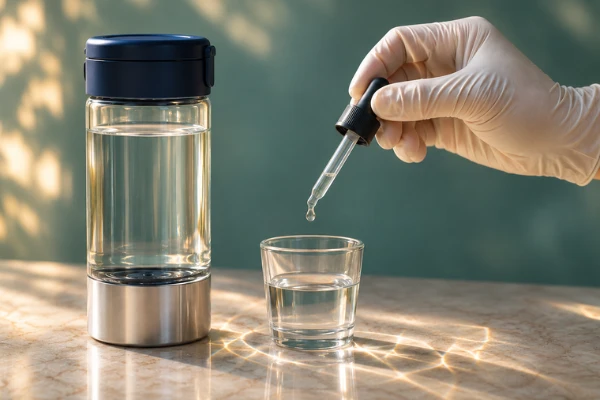
Say you’re looking at a hydrogen water bottle advertised as reaching “up to 5,000 PPB.” The screen shows 5,000 PPB too, but a separate test reads 2,500 PPB. These numbers are fictional, but they raise a practical question. What is each number actually telling you?
Timing is one clue. A sample taken right after the cycle ends may give a different reading from one taken after pouring.
Using manufacturer documentation and published lab reports, this guide explains when you can fairly compare those numbers and what evidence to ask the manufacturer for.
Pick your question to see what to do next.
What Does an Advertised Hydrogen Water PPB Claim Actually Mean?

If a hydrogen water bottle advertises “up to 5,000 PPB,” the manufacturer is saying the bottle can reach that concentration under certain conditions. The first thing to check is what those conditions were.
A concentration unit is not a performance guarantee
PPB stands for parts per billion and, on a mass basis, describes the amount of dissolved hydrogen relative to the water sample’s mass. In dilute water, 1,000 mass based PPB equals 1 mass based PPM, or about 1 mg/L.
For more on converting these units, see our guide to hydrogen water PPB vs PPM.
Note the unit each source uses, then convert both figures to the same unit before comparing them. Check whether each figure is a peak, an average, or a single reading. Treat a figure as a guaranteed minimum only if the manufacturer explicitly guarantees it and provides supporting evidence. Bottle quality and health benefits require separate evidence.
The number needs conditions attached
Look for the exact model and version, water type and fill level, cycle duration and count, measurement method, and sampling time. A built in 20 minute program and two consecutive 10 minute cycles are different test conditions.
Does a Hydrogen Water Bottle's PPB Display Measure Actual Hydrogen Levels?

A PPB or PPM display can show either a software estimate or a sensor reading. If you’re comparing the screen with a separate test, first check how your bottle gets its number.
Estimated counters versus dissolved H₂ sensors
A software counter can estimate concentration from the cycle duration and the bottle’s expected output. A hydrogen selective sensor measures dissolved molecular hydrogen in the water. The reliability of that reading depends on the sensor’s measurement range, its calibration, and how the sample is handled.
How the Echo Flask estimates PPM
In its Echo Flask screen guide, Echo Water explains that the Flask calculates its displayed PPM from cycle duration and expected performance. The Flask has no built in dissolved hydrogen sensor, so the changing number on the screen reflects an updated estimate as the cycle runs.
| Estimated Screen Number | Measured H₂ in a Sample |
|---|---|
| Software estimates the concentration from cycle time and expected output. | A hydrogen-specific test measures dissolved H₂ in the water sample. |
What the owner should verify
Ask the manufacturer whether your model uses a hydrogen specific sensor or a software counter. If it’s a counter, ask what goes into the calculation and whether the manufacturer has compared the displayed values with measured samples from the same model under comparable conditions.
The International Hydrogen Standards Association’s measurement guide explains that oxidation reduction potential (ORP) measures a different property of the water. If software converts an ORP reading into PPB, the result is still an estimate based on ORP.
Tap the description that matches your manual or product page.
It says “estimated PPB” or “estimated PPM”
The bottle is showing a calculation. Ask what goes into it and whether the manufacturer checked the estimate against measured water samples.
It mentions a built-in sensor
Check what the sensor measures. Look for an explicit reference to dissolved molecular hydrogen (H₂), then ask for the sensor’s measurement range and any calibration guidance.
It shows a number with no explanation
Send the manufacturer your exact model name and ask, “What does the display measure, and how is the PPB or PPM value calculated?”
Six Reasons Measured PPB Can Differ From the Claim

When a hydrogen water bottle gives you a different PPB reading from the one advertised, start by comparing how the two numbers were obtained. Here are six details that can explain the gap.
1. Cycle length and consecutive cycles
A 5 , 10 , 20 , or 40 minute run represents a different test condition. Doubling the runtime may change the reading, but there’s no fixed multiplier. Check whether the report used a built in 20 minute program or ran two 10-minute cycles back to back.
2. Water volume and fill level
PPB describes concentration. The total amount of dissolved hydrogen also depends on how much water is in the bottle. Match the reported fill level where possible, since changing the volume can affect how the generator performs.
3. Water source and temperature
Water chemistry can affect hydrogen production depending on the bottle’s design, and temperature can influence how much gas stays dissolved. Check which water types your manual allows and what the lab used before comparing results.
4. Pressure, seal, opening, and delay
A sealed, pressurized bottle can hold more dissolved hydrogen. Once you open it, pouring, shaking, or waiting can change the concentration. Follow your manual when releasing pressure. A sample taken right after the cycle tells you about that moment.
5. The condition of your bottle
Check the charge, cap seal, and cleaning instructions for your model. Wear can matter, too, depending on the design. One low reading leaves the cause open. For a model specific example, see the Echo Flask user manual.
6. What measured the hydrogen
Gas chromatography is a lab method. Hydrogen reagent drops give a kit dependent estimate, while a calibrated hydrogen selective sensor measures dissolved H₂. TDS tracks dissolved solids, and ORP measures redox potential. Bubbles and taste can’t tell you how much hydrogen is dissolved.
Water is sampled as soon as the bottle opens.
Water is sampled after pouring or waiting.
For a fair PPB comparison, check how soon each sample was taken.
What Real Laboratory Reports Reveal About PPB Differences

The clearest comparison is within the same model. In the Echo Flask report, the mean rose from 6.07 mg/L after 10 minutes to 8.25 mg/L after 20 minutes. The lab used distilled water and sampled it right after each program, so you can see exactly which conditions those averages describe.
| Bottle Tested | Test Conditions | Reported Mean Dissolved H₂ |
|---|---|---|
| Piurify 10 oz Hydrogenator | Test conditions One cycle lasting 10 minutes. Distilled water, immediate sampling, static headspace gas chromatography, and three trials. | Reported mean dissolved H₂ 4,090 PPB Piurify 10 oz lab report |
| Piurify 17 oz (PHB2026) | Test conditions One cycle lasting 10 minutes compared with the reported test at 40 minutes. Distilled water, immediate sampling, and gas chromatography. | Reported mean dissolved H₂ 4,240 vs. 9,970 PPB Piurify PHB2026 lab report |
| Echo Flask (EC-Machine Flask) | Test conditions Bottle programs lasting 10 and 20 minutes. Distilled water, immediate sampling, gas chromatography, and three trials per program. | Reported mean dissolved H₂ 6.07 vs. 8.25 mg/L Echo Flask lab report |
Piurify also commissioned its reports, and H2 Analytics performed the measurements for both brands. A fair comparison across brands would require independently selected retail units tested under the same conditions.
If you have a report for your own model, here’s how to read and verify a hydrogen water bottle lab report.
If you want to know how much hydrogen remains by the time you drink the water, you’d need a sample taken at that point.
Match your test to the published report. Your next step appears below.
Choose an answer to see what to check next.
Advertised PPB vs Display PPB vs Measured PPB: Which Number Matters?

If you want to know how much hydrogen was dissolved in the water you sampled, start with a hydrogen specific test and check how it was done. The three fictional numbers from the introduction show why the source of each figure matters.
| Number in the Example | What It Tells You |
|---|---|
| Ad “Up to 5,000 PPB” | The concentration the manufacturer claims the bottle can reach. Check whether the figure came from a peak, an average, or a single trial, and how it was measured. |
| Screen 5,000 PPB | The value the bottle displays. Check whether your model measures dissolved hydrogen with a sensor or calculates an estimate. |
| Separate Test Estimated 2,500 PPB | The estimated concentration in that sample. Check the test conditions before drawing conclusions about the gap. |
The claim to consumption evidence ladder
Manufacturer’s claim → Documented lab result for that model → Sample measured at the time of drinking, if available → Separate question about health effects
A sample taken right after the cycle describes the water at that moment. If you drink it later, you’d need a sample taken then to know the concentration.
The six field fair comparison check
- Exact bottle model and version
- Original units and whether the claim is a peak, average, or guaranteed minimum
- Cycle count and duration
- Water type, fill level, and temperature
- Timing of opening and sampling
- Hydrogen specific measurement method
If a detail is missing, treat the comparison as incomplete and find out what’s missing before judging the gap.
When Should a Lower PPB Result Concern You and What Next?

In a Reddit discussion about hydrogen water bottles, one owner said their bottle was advertised at 8,000 but gave them a reading of 1,300 after two cycles. The commenter didn’t specify the units, test method, or sampling time, so the reason for the gap remains unclear.
If this happens to you, check that the “up to” claim applies to your exact model. Use the checklist above to match the conditions, then repeat the test with a hydrogen specific method. Screen estimates, ORP, and TDS measure or describe different things.
Follow your manual’s guidance on water, charging, seals, cleaning, and pressure release. Test the bottle as supplied. Record the method, sampling delay, and result.
For step by step instructions, see how to test a hydrogen water bottle at home.
Ask the manufacturer:
- Is the advertised figure a peak or an average?
- What exact conditions produced it?
- Does the display use a hydrogen sensor or a software estimate?
- Can you share my model’s lab report and explain the return or warranty requirements?
If comparable tests consistently come back lower, send support your records. If the result is disputed, consider a lab that measures dissolved hydrogen.
Still getting low readings under comparable conditions? Include these four details.
-
01
Bottle model
Exact model and version.
-
02
Cycle and water
Program, cycle count, water type, and fill level.
-
03
Test and timing
Hydrogen test used and when you took the sample.
-
04
Repeat readings
Each result with its unit, such as PPB or mg/L.
What PPB Results Cannot Establish

A PPB result describes the dissolved hydrogen in one sample under specific conditions. You’d need separate measurements to know how much remains after the water sits, how consistently other units perform, or how well the bottle holds up over time.
Water safety and health effects call for different evidence. Contaminants need their own tests, while questions about health benefits or an effective dose require clinical research. A hydrogen concentration reading leaves those questions open.
Frequently Asked Questions
Does “up to 5,000 PPB” mean every cycle will reach that level?
No. Treat it as a minimum only if the manufacturer explicitly guarantees it under stated conditions.
Why is the PPB screen higher than my independent result?
The screen may show a software estimate. Check how your model gets its number, when you sampled the water, and what your test can measure.
Does a longer or repeated cycle always give higher PPB?
No. Results depend on bottle design and test conditions. Compare the exact program and cycle count.
Can TDS, ORP, or bubbles tell me the actual hydrogen concentration?
No. TDS measures dissolved solids, ORP measures redox potential, and bubbles alone can’t quantify dissolved hydrogen.
Does one low reading mean my bottle is fake?
No. Repeat the test under comparable conditions and ask for the lab report for your exact model.
Does a high PPB prove a health benefit?
No. Hydrogen concentration, drinking water safety, and health benefits each require separate evidence.
Final Thoughts: Read the Number With Its Conditions
Got a lower PPB reading than the ad or screen shows? The ad states a claim, the screen may show an estimate, and a documented lab result tells you what was measured in one sample. The concentration when you drink it depends on a measurement taken then.
Before judging the gap, check your exact model’s report for the cycle, test method, and sampling time.
About the Author
Zaryab contributes research, content development, and website management at Water Bottle Experts, working alongside her sister, Zainab, the site's Founder and Research Lead. Her approach combines genuine everyday drinkware experience with manufacturer documentation, published research, and product-owner feedback. She focuses on turning technical product information into practical guidance that readers can understand and apply. For hydrogen water topics, Zaryab pays particular attention to measurement methods, test conditions, and the evidence behind advertised performance claims. Her goal is to help readers distinguish documented results from estimates and unsupported assumptions without presenting research-based findings as firsthand laboratory testing.
About This Article
This article was researched and written by Zaryab at Water Bottle Experts to help readers understand why advertised hydrogen concentration claims, digital PPB displays, and actual measurements may show different results.
Our research draws on published H₂ Analytics laboratory reports for Piurify and Echo bottles, Echo Water’s official explanation of its estimated PPM display, and the International Hydrogen Standards Association’s measurement guidance.
We examined how cycle duration, water conditions, sampling time, and measurement methods affect the interpretation of reported results. Manufacturer-commissioned laboratory findings are distinguished from advertising claims and independently replicated evidence.
This guide is based on document analysis and published research, not original hydrogen concentration testing conducted by our team. The numerical comparison scenarios are illustrative, not actual measurements.